
Reviews
Part of Newsletter subject line testing: which UK tools work best?
Newsletter subject line testing: which UK tools work best?
Compare UK subject line testing tools: Mailchimp, Campaign Monitor, Dotdigital, Spotler and Phrasee, plus GDPR duties and British English checks.
What to take away
- Subject line testing covers three jobs: writing variants, splitting delivery and measuring the result. Most UK platforms do the split, while specialists do the copy.
- Named tools below include Mailchimp, Campaign Monitor, Dotdigital, Spotler and Phrasee. Ometria also appears for retail teams.
- Compliance stays with the sender. The software may hold the addresses, but consent, suppression and unsubscribe handling are your duty.
- British English wording shifts results more than punctuation, capitals or emoji.
- Pick the metric before you open the toolopens, clicks, or revenue per recipient.
Compliance comes before copy
Any tool that stores subscriber addresses, builds segments or tracks opens is processing personal data. The ICO's guidance on the UK GDPR sets out the lawful basis, minimisation and access rights that apply to that record, whichever product writes the subject line.
Marketing by electronic means needs its own basis, separate from the newsletter's editorial purpose. The Data Protection Act 2018 sets the framework the ICO applies when consent is thin or unclear.
For the field-by-field view of what a compliant subscriber record holds, our notes on subscriber data under UK GDPR list each field and say who owns it.
A subject line that promises a discount or a free gift is an advertising claim. The CAP Code covers marketing emails, so keep the wording defensible and the offer real.
UK tools compared by job
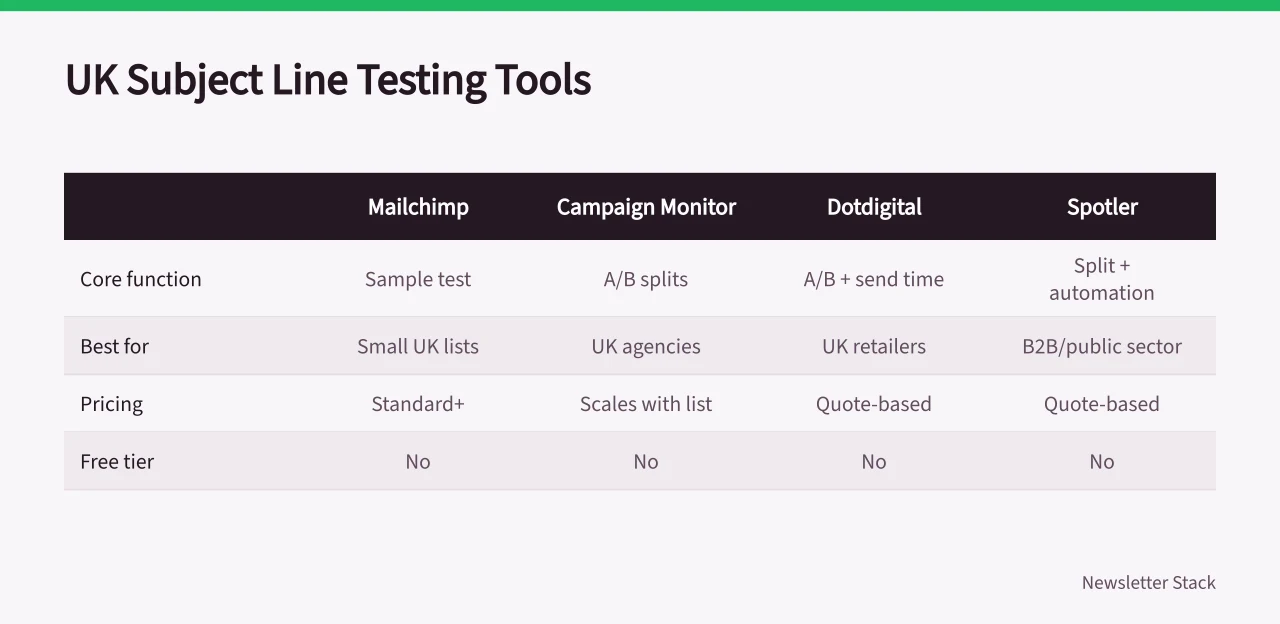
What it does
- Mailchimp
- Tests subject lines on a sample, then sends the winner to the rest.
- Campaign Monitor
- Runs A/B splits on subject lines and content.
- Dotdigital
- UK platform with A/B testing and send-time optimisation.
- Spotler
- UK email suite with split testing and automation.
- Phrasee
- UK AI copywriting that generates subject lines in brand voice.
- Ometria
- UK retail CRM with subject line and campaign testing.
Who it suits
- Mailchimp
- Small UK lists already on Mailchimp.
- Campaign Monitor
- UK agencies and publishers wanting drag-and-drop.
- Dotdigital
- UK retailers and publishers needing local support.
- Spotler
- B2B teams and public sector bodies.
- Phrasee
- Large UK brands with high send volume.
- Ometria
- Retailers with a UK customer base.
Pricing or limit
- Mailchimp
- A/B testing sits on Standard and above, not the free plan.
- Campaign Monitor
- Pricing scales with list size; no free tier for full sends.
- Dotdigital
- Quote-based pricing; London headquarters.
- Spotler
- Quote-based pricing; Guildford headquarters.
- Phrasee
- Enterprise pricing; no self-serve free tier.
- Ometria
- Quote-based pricing; aimed at mid-market and enterprise.
For most UK newsletters, the split test belongs in the delivery platform. Dotdigital and Spotler are the closest fit for UK-based teams. Mailchimp and Campaign Monitor suit smaller lists and agencies. Phrasee fits large brands that need copy variants at scale. Ometria fits retailers.
A free score-based checker such as SubjectLine.com can flag length and spam words. Its rules are tuned to US phrasing, so treat it as a draft check. It is not evidence from your readers.
A five-step testing sequence
- Write the hypothesis in one sentence, naming the reader and the outcome.
- Fix the sample share and the decision window before the send, not after.
- Change one element onlywording, length, a question against a statement.
- Hold send time, segment and offer steady so the comparison survives.
- Log the date, list size, winner and margin in a file you keep.
Keep the brief short. A test that needs a meeting to explain will not survive a busy week.
Five-Step Testing Sequence
- Write hypothesis naming reader and outcome
- Fix sample share and decision window
- Change one element only
- Hold send time, segment, offer steady
- Log date, list size, winner, margin
British English phrasing changes what you test
Audience expectations differ across the Atlantic. An audience built from UK trade press reads 'organise' and 'programme' as normal; a US-published variant can read as a foreign send.
UK vs US English Differences
UK English
- Spelling
- organise, programme
- Currency
- £49
- Date order
- 3/4/2026 = March
- Holidays
- Bank holiday dates vary
- Spam scores
- Tuned to UK rules
US English
- Spelling
- organize, program
- Currency
- 49 GBP
- Date order
- 3/4/2026 = April
- Holidays
- Different holiday schedule
- Spam scores
- Tuned to US rules
Test currency symbols and date order alongside wording. A price shown as £49 lands differently from one shown as 49 GBP, and 3/4/2026 is read as March by some readers and April by others.
Seasonal references are the hardest to move between markets. A bank holiday send reads clearly in England and Wales; Scotland and Northern Ireland keep different dates.
Spam-trigger scores from US tools are tuned to American phrasing and American rules. Treat them as a starting point for a draft, not a verdict on a UK send.
Once the copy is settled, the tool question becomes a workflow question. Splitting the requirement into functions before you compare suppliers keeps subject line testing separate from delivery and billing.
Reading results without fooling yourself
Opens are a qualified proxy, not a demand signal. A subject line that lifts opens but not clicks has moved curiosity, not interest.
Segment by sign-up source. Readers who arrived through a referral link are not the same population as those from a paid ad, so test within one source at a time.
Run the same test across three or four sends before you rewrite your house style. One result from one Tuesday is a data point, not a finding.
Common questions
Which UK tool works best for a small newsletter?
Mailchimp and Campaign Monitor are common choices for small UK lists. Both include split testing, but Mailchimp keeps A/B testing behind its Standard plan.
Which tool is best for British English copy?
Phrasee is built in the UK and generates variants in a brand voice. It suits high-volume senders with budget for enterprise software, not one-person lists.
Do I need a separate subject line testing tool?
Not always. If your delivery platform splits a sample and reports by variant, an external tester adds a second opinion on phrasing rather than fresh evidence from your list.
How large a sample does a test need?
There is no fixed threshold, and small lists give noisy results. If your active readership is in the hundreds, test across several sends rather than reading one.
What should I record after each test?
The date, list size, variant and metric. Add the result, margin and who approved the copy. That log turns a one-off result into a rule you can reuse.
Does a subject line tester hold subscriber data?
It depends on what the tool receives. If it takes address lists rather than subject line text alone, it is a processor and needs a written agreement with you.